
Sie haben die Stelle ausgeschrieben. Bewerbungen gingen ein. Die Lebensläufe sahen vielversprechend aus. Wochen vergingen. Immer noch keine Einstellung. Das ist das Muster, das ausländische Unternehmen am meisten am Einstellungsprozess in Polen frustriert. Und es ist nicht das, was sie erwartet haben. Polen verfügt über eine der größten Tech-Arbeitskräfte Europas, einen großen Strom von MINT-Absolventen und eine wachsende internationale Belegschaft. Auf […]
Sie haben die Stelle ausgeschrieben. Es kamen Bewerbungen rein. Die Lebensläufe sahen vielversprechend aus. Wochen vergingen. Immer noch keine Einstellung.
Dies ist das Muster, das ausländische Unternehmen bei der Einstellung in am meisten frustriert Polen. Und es ist nicht das, was sie erwartet haben.
Polen hat eine der größten Tech-Arbeitskräfte Europas, einen großen Strom von MINT-Absolventen und eine wachsende internationale Belegschaft. Auf dem Papier ist das Talent vorhanden.
Der Fachkräftemangel in Polen 2026 ist real, aber er ist nicht das, was die meisten Unternehmen denken. Es ist kein Mangel an Menschen. Es ist ein Mangel an den richtigen Menschen, mit der richtigen Erfahrung, zum richtigen Preis verfügbar, über die richtigen Kanäle erreichbar.
Diese Unterscheidung ist von enormer Bedeutung für die Art und Weise, wie Unternehmen ihre Suche angehen.
Die offizielle Arbeitslosenquote allein ist irreführend. Nach harmonisierten Maßstäben liegt die Arbeitslosenquote in Polen bei etwa 3 bis 4%, womit das Land zu den Ländern mit den besten Werten in der EU zählt. Doch eine Arbeitslosenquote von 3% in einem Land mit 37 Millionen Einwohnern bedeutet nicht, dass jeder, der Arbeit sucht, in einem ungeeigneten Beruf tätig ist. Es bedeutet vielmehr, dass der Arbeitsmarkt angespannt ist. Sehr angespannt.
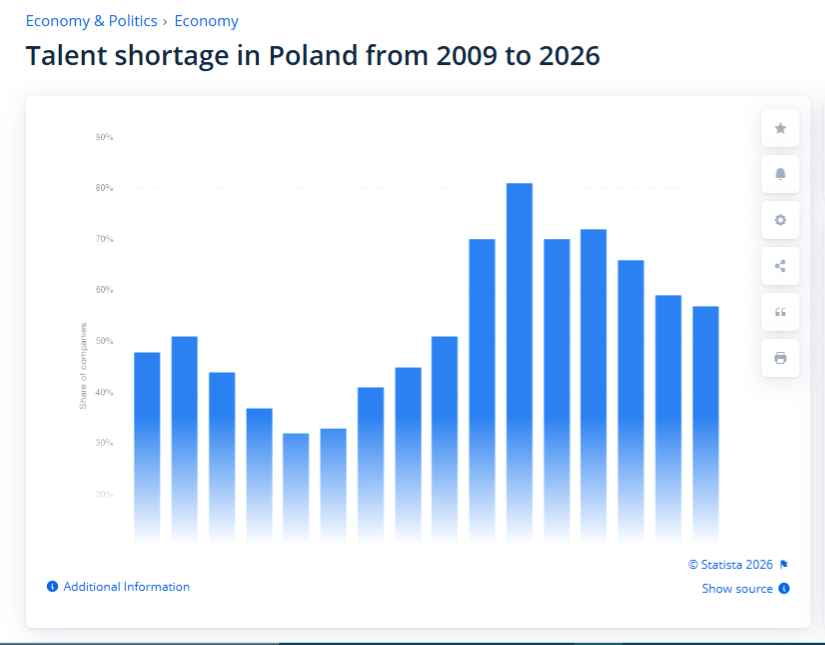
Im ersten Quartal 2025 meldeten polnische Arbeitgeber 112.000 Stellen, die trotz intensiver Personalbemühungen unbesetzt blieben. Die Hälfte der befragten Unternehmen nannte den Arbeitskräftemangel als wesentliche operative Hürde. Fast 70% polnischer Arbeitgeber gaben an, dass sie im Jahr 2024 Schwierigkeiten hatten, Mitarbeiter zu finden., und die Bedingungen haben sich seitdem nicht grundlegend verbessert.
Mehrere strukturelle Kräfte treiben dies an.
Eine alternde Belegschaft ohne einfache Nachfolge. Das Medianealter Polens erreichte 2024 43,3 Jahre, und die Statistikbehörde Polens prognostiziert, dass die Bevölkerung im erwerbsfähigen Alter bis 2040 um rund zwei Millionen Menschen schrumpfen wird. Ältere Ingenieure gehen mit über Jahre entwickelter Erfahrung in den Ruhestand. Junge Absolventen ersetzen sie nicht im Verhältnis eins zu eins.
Jugendabwanderung zapft die Pipeline an. Junge polnische Fachkräfte verlassen das Land weiterhin auf der Suche nach besser bezahlten Stellen in Deutschland, den Niederlanden und im Vereinigten Königreich. Der Gehalt Die Lücke zu Westeuropa hat sich im Top-Management verringert, aber für Berufseinsteiger bleiben London oder Amsterdam weiterhin attraktiv.
Schnelle digitale Transformation überholt die Bildung. Die Nachfrage nach KI, Cloud und Cybersicherheit ist explodiert. Die Universitätslehrpläne in Polen, wie in den meisten Teilen Europas, sind damit nicht Schritt gehalten. Der Mangel an IKT-Fachkräften in Polen wird auf 40.000 bis 50.000 Mitarbeiter geschätzt., eine Figur, die speziell durch die Diskrepanz zwischen dem angetrieben wird, was Unternehmen benötigen, und dem, was das Bildungssystem derzeit hervorbringt.
Ausländische Investitionen verknappen das Angebot weiter. Jedes neue F&E-Zentrum, jede neue Technologie-Delivery-Einheit, jeder neue Shared-Services-Standort, der in Warschau oder Krakau eröffnet wird, schöpft aus demselben Pool. 84% der Arbeitgeber in Polen planen, im Jahr 2026 neue Mitarbeiter einzustellen, was bedeutet, dass Unternehmen nicht nur mit direkten Branchenrivalen konkurrieren. Sie konkurrieren mit jedermann.
Der Mangel ist nicht in allen Rollen einheitlich. Er konzentriert sich auf bestimmte Disziplinen, und das Verständnis, wo er liegt, ist der Ausgangspunkt für eine realistische Einstellungplanung.
Hierauf konzentrieren sich die Schlagzeilen, und das aus gutem Grund.
Die gefragtesten und am schwierigsten zu besetzenden Stellen in Polen sind Cybersicherheitsspezialisten, KI- und Machine-Learning-Experten, Softwareentwickler, Datenanalysten und Cloud-Ingenieure. Dies sind auch die Rollen, bei denen die Lücke zwischen dem, was Unternehmen benötigen, und dem, was der Markt liefern kann, am größten ist.
KI-Ingenieure sind der kritischste Engpass im Jahr 2026. 75% der IT-Arbeitgeber in Polen suchen gezielt nach Fachkräften mit Kenntnissen in den Bereichen KI und maschinelles Lernen, aber der Pool an erfahrenen Fachkräften mit echter Produktionserfahrung in angewandter KI ist im Hunderter-, nicht im Tausenderbereich angesiedelt. DevOps- und Cloud-Architekten sehen sich einer ähnlichen Dynamik gegenüber: Cloud-Zertifizierungen haben sich zwar vermehrt, aber Praktiker, die wirklich komplexe Cloud-native Infrastrukturen im großen Maßstab entwerfen und betreiben können, bleiben rar. Cybersicherheitsexperten konkurrieren mit Unternehmen aus allen Sektoren, angetrieben durch die NIS2- und EU-KI-Verordnungs-Compliance-Anforderungen, die Sicherheitsexpertise in vielen Branchen von optional zu gesetzlich vorgeschrieben gemacht haben.
Lieferengpässe in der Produktion erhalten tendenziell weniger Aufmerksamkeit als Tech-Themen, sind aber strukturell bedeutsam.
Der Fachkräftemangel in der produzierenden Industrie konzentriert sich auf Automatisierungsingenieure, Anlagenfachleute und versierte Instandhaltungsexperten, insbesondere da sich das polnische verarbeitende Gewerbe von der Massenproduktion hin zu industriellen Tätigkeiten mit höherer Wertschöpfung in den Bereichen Automobil, Luft- und Raumfahrt sowie grüne Energie entwickelt hat. Die Herausforderung ist hier oft weniger sichtbar als im Technologiesektor, da produzierende Unternehmen weniger öffentlich einstellen, aber sie ist nicht weniger real. Facharbeiter, Elektriker, Schweißer und Elektromonteure stehen durchweg an der Spitze der offiziellen Liste der Mangelberufe.
Das Gesundheitswesen hat einen eigenen strukturellen Mangel, und der demografische Druck verschärft diesen Jahr für Jahr.
Zu den offiziellen Mangelberufen in Polen gehören Ärzte, Krankenschwestern und Hebammen in fast allen Regionen. Der Mangel an Geriatrie- und Fachärzten ist besonders gravierend und spiegelt sowohl die alternde Patientenpopulation als auch die Abwanderung von medizinischem Fachpersonal in besser bezahlte Gesundheitssysteme in Deutschland und Skandinavien wider. Laborspezialisten und klinische Apotheker runden die Liste der Rollen ab, die über Standard-Rekrutierungskanäle weiterhin schwer zu besetzen sind.
Das Wachstum des polnischen Shared-Services-Sektors hat eine anhaltende Nachfrage nach Finanz- und Compliance-Experten geschaffen, mit der die heimische Lieferkette noch nicht vollständig Schritt halten konnte.
Risikoanalysten, Compliance-Spezialisten und Finanzcontroller mit IFRS-Erfahrung oder Erfahrung bei einer der "Big Four"-Wirtschaftsprüfungsgesellschaften sind in Warschau und Krakau hart umkämpft. Die Finanz- und E-Commerce-Branche sucht gezielt nach Spezialisten für Rechnungswesen und Business-Analysten., and the multilingual dimension adds another constraint: a compliance specialist fluent in English and German is a materially different and considerably rarer profile than one operating only in Polish.

Here is the paradox that confuses most foreign employers. They post a role. Applications arrive. The calendar fills with interviews. Three months later, the seat is still empty.
The CV says yes. The interview says no.
The shortage in Poland is often about the quality of applications, not the quantity. A junior developer who has used a technology in a side project is not the same as a senior engineer who has deployed it in a production environment serving a million users. The difference between “listed skill” and “working capability” is larger in fast-moving disciplines like AI, cloud, and cybersecurity than almost anywhere else.
In engineering specifically, more than 50% of candidates lack the technical skills companies need, according to assessments by hiring managers themselves. The CVs look fine. The interviews reveal the gap.
Candidates arrive at interviews knowing the market. Companies arrive with benchmarks that are a year old.
Average monthly gross pay in Poland’s enterprise sector reached PLN 9,582.91 in December 2025, up 8.6% year on year. For senior tech roles, the growth has been steeper. A company that benchmarked salaries in early 2025 and has not revisited those figures is already offering below market before the candidate walks through the door.
See our Durchschnittliche Gehälter in Polen nach Branche (Gehaltsleitfaden 2026) for current benchmarks across every major sector.
Job boards surface every candidate who clicks “apply,” not the ones who are actually at the level the role requires. When a company is sifting through 120 applications for a senior cloud architect role, most of those 120 people are mid-level engineers who applied speculatively. The two or three who genuinely match the brief can get lost in the noise, and the company exhausts its interview capacity before finding them.
Strong candidates disappear fast in Poland’s tight market. The strongest candidates in scarce disciplines are typically in active conversation with three to five companies simultaneously. A company that takes two weeks to schedule a first interview, another two weeks to debrief, and then needs three more internal approval rounds before extending an offer will consistently lose to faster-moving competitors.
There is a structural argument buried beneath the headline statistics, and it is worth understanding clearly.
Poland produces roughly 74,000 STEM graduates per year. That sounds like a substantial number. But the market’s demand has shifted significantly faster than the education system has responded.
Universities in Poland, as across most of Europe, are not yet producing AI engineers, cloud architects, or cybersecurity specialists at anything close to the volume the market needs. The curriculum catches up to industry practice on a cycle measured in years. The skills the market urgently needs in 2026 were not even clearly defined as distinct disciplines when most current students enrolled.
The Polish ICT sector employs approximately 250,000 people, and when specialists working outside the ICT sector are included, the total reaches around 300,000. But the shortage of ICT workers is estimated at 40,000 to 50,000 employees, a gap that represents roughly 15% of the current workforce and cannot be closed through graduate recruitment alone.
The important nuance, and the one most company briefings miss, is that the shortage concentrates at the senior end, not the junior end. Poland has reasonable availability of junior and mid-level generalist engineers. The scarcity sits in specialists who combine five-plus years of focused experience with current, production-environment capability in high-demand disciplines. Junior developers compete for just 4.79% of all IT job offers in Poland in 2025 and 2026, meaning the market has oriented itself aggressively around experienced talent. Companies looking for senior volume are looking in the most competitive segment of the market by design.
The talent shortage is real. Foreign companies also, consistently and predictably, make it harder than it needs to be.
Wanting senior talent at mid-level pay is the most common pattern. It happens for a straightforward reason: the budget was set before anyone checked what the current market actually requires, using data that was already outdated at the point of budget approval.
Seven interview stages is not rigorous. It is a process that was designed to make the hiring team feel certain, at the cost of every strong candidate who exits before reaching the offer stage.
The typical timeline that loses candidates in Poland runs something like: first interview in week two, debrief in week four, second panel in week six, leadership review in week eight, offer discussion in week ten, offer extended in week twelve. The candidate accepted a competing offer in week five.
Companies without a clear employer narrative struggle to attract interest, even with competitive salaries. A senior AI engineer in Warsaw is not going to leave a well-known, well-paying role for an unknown company based on a LinkedIn InMail and a PDF job description. The employer story, the engineering culture, the growth trajectory, the answer to “why would I leave where I am for you”: all of it needs to exist and be communicable before the search opens.
“We’re looking for a passionate, results-driven engineer to join our growing team” is not a job description. It is a template. And in a market where the best candidates receive multiple approaches per week, a generic description is sorted into the “not worth my time” pile almost immediately.
For the complete picture of avoidable hiring Fehler, see our guide Häufige Einstellungsfehler ausländischer Unternehmen in Polen.

The talent shortage is structural. That does not mean individual companies are helpless. The ones consistently closing good hires in Poland do specific things differently.
A 7 to 14 day decision cycle from first interview to offer is not ambitious. It is table stakes in a market where the best candidates disappear in two to three weeks. This requires pre-aligned internal processes, pre-set assessment criteria, and leadership availability built into the hiring calendar before the search opens, not scheduled after a candidate is already in hand.
Warsaw is Poland’s deepest market and its most competitive. Kraków, Wrocław, Poznań, and Katowice all carry genuine technical depth, with salary expectations running 10 to 20% below Warsaw levels depending on the role. For companies that do not have a specific reason to anchor in the capital, widening the search geography consistently produces faster hires at lower total cost.
A large proportion of senior Polish professionals prefer B2B arrangements over employment contracts, for tax efficiency and professional autonomy. Companies that offer only one contract structure cut themselves off from candidates who will not accept the other. Presenting both options, with compensation correctly structured for each, immediately widens the accessible candidate pool without raising the budget.
Passive candidates, those not actively looking but potentially open to the right opportunity, are unreachable through job boards. They are reachable through direct, credible outreach from recruiters with established relationships in the specific market.
The talent search carried out by employers involves increased competition, often leaving candidates frustrated due to the lack of responses to their applications on standard channels. Specialist recruiters sidestep that competition by reaching the candidates who are not on those channels at all.
The short answer is: not soon.
The forces driving the shortage, demographic contraction, continued emigration of experienced professionals, and AI-driven demand growth, are all structural rather than cyclical. They do not resolve in a single hiring year or even a single economic cycle.
Without sustained immigration at scale, working-age population decline will constrain economic activity and workforce supply in Poland through the remainder of the decade. The government’s 2025 to 2030 labour market strategy acknowledges this explicitly, projecting that international workers will need to make up at least 12% of the workforce by 2030 just to maintain current growth rates.
AI demand is not slowing down either. Every company that added an AI mandate to its strategy in 2025 is now looking for engineers who can deliver on it. The number of genuinely senior AI practitioners available in Poland grew more slowly than the demand did.
2027 will likely remain a competitive hiring environment, particularly for specialist tech roles, engineering, and healthcare. The companies that build a deliberate Poland recruitment strategy now, including employer branding, a fast decision process, and reliable specialist access, will be significantly better positioned than those waiting for the market to ease.
Is there a talent shortage in Poland in 2026?
Yes. Poland faces shortages in technology, engineering, healthcare, and specialist finance roles because demand exceeds qualified supply. Nearly 70% of employers in Poland reported difficulty finding employees in 2024, and the situation has not materially improved in 2026. The shortage is structural, driven by an aging population, youth emigration, and demand from technology and AI that has outpaced the education system.
Why is it hard to hire specialists in Poland?
The main reasons are a skills gap between what education produces and what the market needs, rising salary expectations that many foreign companies underestimate, intense competition for the same small pool of experienced candidates, and slow internal hiring processes that lose candidates to faster-moving competitors. The shortage concentrates specifically at the senior end of the market.
Which jobs are hardest to fill in Poland?
AI, cybersecurity, DevOps, cloud architecture, and data engineering roles are among the hardest to fill in the tech sector. In manufacturing, automation engineers and skilled maintenance specialists are consistently difficult. In healthcare, doctors and nurses remain on the official shortage occupation lists across nearly every Polish region. In finance, compliance specialists and risk analysts with international experience are persistently scarce.
How can companies solve talent shortages in Poland?
The most effective combination: update salary benchmarks to current market rates, compress hiring decision cycles to 7 to 14 days, offer both B2B and employment contract options, extend the search to secondary cities beyond Warsaw, and work with specialist recruiters who maintain active relationships with passive candidates in the disciplines you need.
Poland still offers one of Europe’s strongest talent markets. But accessing that talent is becoming increasingly difficult for companies hiring alone.
At BrainSource, we help international companies hire hard-to-find specialists across Poland faster through specialist recruiter networks, real-time market intelligence, and targeted headhunting.
Whether you need AI engineers, cybersecurity experts, manufacturing specialists, or senior leadership talent, the right recruitment partner can dramatically reduce hiring time and improve placement quality.
If specialist roles are staying open longer than they should, it may be time to rethink how you hire.
Explore more: Durchschnittliche Gehälter in Polen nach Branche (Gehaltsleitfaden 2026), Häufige Einstellungsfehler ausländischer Unternehmen in Polen, IT Recruitment in Poland, Beste Städte für die Talentgewinnung in Polen, und Top 10 Personalvermittlungsagenturen in Polen.
 English English
  Romanian
 Polish
 German